
Last updated October 30, 2026
 Home additions & ADU
 Kitchen remodeling
 Bathroom remodeling
 Roofing
 Windows & doors
 Driveway & pavers
 Fence
Free written scope consultation - allowances, timeline, and change-order rules on paper before a single trade is scheduled
General Contractor Maintenance Checklist for Indio Homeowners
A standard asphalt shingle rated for 30 years in Portland may reach end-of-life in 12 to 15 years in Indio, yet most homeowners are still running the same inspection schedule their builder handed them at closing. The Coachella Valley does not age a house gradually. It accelerates specific failure points you can see coming if you know where to look. This checklist is built for Indio specifically: what breaks here, why it breaks on a compressed timeline, and what a general contractor in Indio actually checks when called out for a second opinion.
Quick Answer
A proper Indio home maintenance checklist prioritizes UV-exposed surfaces (roof coatings, stucco, window glazing), HVAC strain from 2,000-plus-hour cooling seasons, and soil movement caused by rare but violent rain events on compacted desert ground. Most homes here benefit from semi-annual inspections in spring and fall, with roofing and elastomeric coatings checked every 12 to 18 months instead of the 3-to-5-year intervals common in milder climates. The fixes that cost real money in Indio are almost always failures that were visible months before they became emergencies.
Styles & brands we work with
Table of Contents
- The Desert Roof: Why Indio Shingles and Coatings Fail Early
- Reading Stucco Cracks: Cosmetic vs. Water-Intrusion Mapping
- HVAC Strain: Filter and Duct Seal Intervals for Indio’s Cooling Season
- Window Glazing and Seals: UV Degradation at 115°F
- Pool Decks and Hardscape: Soil Heave on Compacted Desert Ground
- Exterior Coatings: Service Intervals for Loxon XP and James Hardie
- The Indio Seasonal Inspection Schedule
- Common Mistakes to Avoid
- When to Call a Professional
- Frequently Asked Questions
The Desert Roof: Why Indio Shingles and Coatings Fail Early
Indio sits in climate zone 15, where roof surfaces regularly absorb 160°F-plus radiant temperatures during July and August. That sustained heat does not just wear shingles down; it breaks the chemical bonds in asphalt granules and dries out elastomeric coatings until they chalk and lose adhesion. We tell homeowners in Indio the same thing: your roof is not aging by calendar years here. It ages by heat hours. A GAF or Owens Corning Duration architectural shingle that would look fresh after a decade in coastal California may show granule loss along southern exposures after five Indio summers.
The most exposed sections fail first. South-facing and west-facing roof planes take the brunt of afternoon UV and often show visible differences in surface texture by year seven. Walk the roof line from the street with binoculars and compare the color consistency across planes. If the sun-exposed side looks washed out or patchy against the shaded side, the granules are releasing. That is the early warning for thermal cracking in the asphalt mat underneath, which leads to the leaks most Indio homeowners only discover during winter rain.
Roof Inspection Checklist for Indio Homes
- Check elastomeric coatings on flat and low-slope sections every 18 months, not every 3 years. Look for chalking, peeling at seams, and pinholes around roof penetrations like vents and skylights.
- Compare granule color and depth between north-facing and south-facing shingle planes. Significant contrast means UV degradation is advancing on the hot side.
- Inspect pipe boots and HVAC curb flashings for dried, cracked rubber. These are often the first leak points in Indio because they sit fully exposed above the roofline.
- Check valley metal and drip edge for rust bloom after monsoon rain. Salt-laden dust settles on metal and accelerates oxidation when it gets wet.
- Look for wind-lifted shingles along the rake edges. Indio’s sustained spring winds find any nail that has backed out from thermal expansion cycles.
When we replace a roof in Indio, we spec materials for heat endurance first, not just warranty length. Owens Corning Duration with SureNail technology holds better under repeated expansion, and for flat sections we lean on elastomeric systems rated for high-UV exposure rather than standard acrylic coatings that turn to powder quickly here.
Reading Stucco Cracks: Cosmetic vs. Water-Intrusion Mapping
Every stucco home in Indio has cracks. Most are cosmetic thermal hairline fractures that open and close with daily temperature swings; a 40-degree overnight-to-afternoon differential moves stucco more than most owners realize. The skill is reading which cracks matter. We teach homeowners a simple rule: if a crack runs wider than the edge of a credit card, is longer than a few feet, or changes width seasonally, it has moved from cosmetic to structural observation. In Indio, hairline cracks around window corners and expansion joints are typical and rarely urgent. Diagonal cracks wider than 1/8 inch from the corner of a door or window, or horizontal cracks along the foundation line, need a professional look.
Monsoon season changes the stakes. Between July and September, a crack that sat harmless through ten dry months becomes a water entry point during a single hard downpour. Indio rainfall is rare but comes fast. Desert stucco is porous. Once water finds a path behind the cured layer, it sits against the building paper and framing, and the summer heat turns the wall cavity into a drying oven that drives moisture deeper instead of evaporating it.
- Map every crack wider than 1/16 inch on a simple diagram each spring. Photos with a reference object (a coin, a pencil) work better than memory.
- Monitor the same cracks after the first monsoon rain. If any have widened, darkened, or begun releasing mineral staining below them, seal and track.
- Seal hairline cracks with an elastomeric caulk rated for exterior movement, like Sherwin-Williams SherMax or equivalent. Standard acrylic caulk fails in one Indio summer.
- For cracks wider than 1/8 inch, or any crack that continues to move after sealing, have a contractor probe for underlying movement or paper damage.
Stucco done right in Indio uses control joints placed where thermal movement concentrates. If your home’s stucco has no apparent control joints, you will fight recurring cracks until the surface is properly relieved. That is a conversation worth having with a contractor who offers General Contractor services in the Coachella Valley full time.
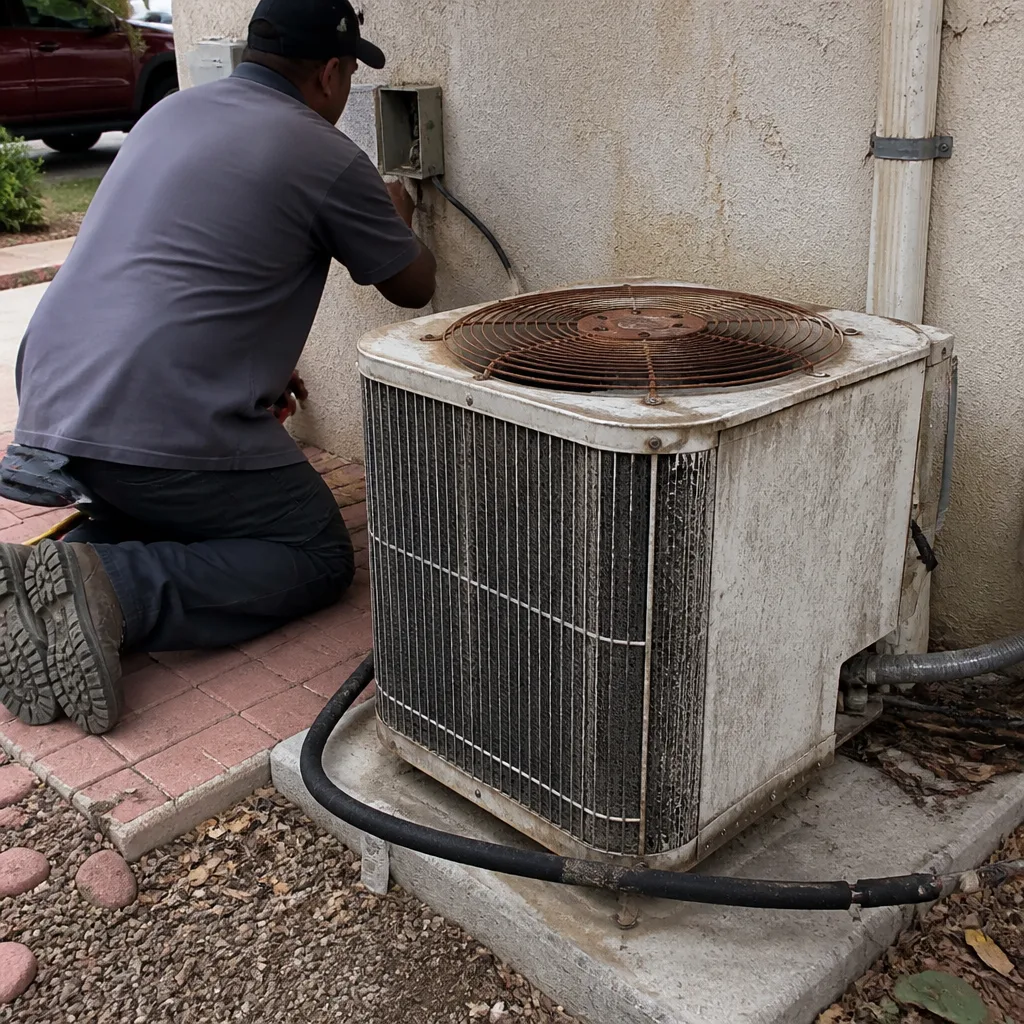
HVAC Strain: Filter and Duct Seal Intervals for Indio’s Cooling Season
An Indio air conditioner runs roughly 2,000 to 2,500 hours per cooling season, about double the national average. That means two things for maintenance: filters clog on a demand schedule, not a calendar schedule, and any small duct leak becomes a measurable energy loss every single day the system runs. A 10% duct leak on a system pushing 2,000 hours per season is not a minor inefficiency. It is real money thrown into the attic.
Most filter manufacturers print 90-day replacement guidance assuming average runtimes. In Indio, a 1-inch filter in a home with pets or near open desert should be checked monthly during May through October and replaced when visibly loaded, often every 6 to 8 weeks. A pleated MERV 8 filter is the practical sweet spot: it catches fine desert dust without restricting airflow enough to strain the blower motor. Higher MERV ratings sound better but reduce airflow on many residential systems, which raises static pressure and shortens compressor life.
Duct seal inspection deserves more attention than it gets in Indio. Attics here regularly bake past 140°F. Duct mastic dries out and cracks. Flex duct outer jackets degrade from the same UV that attacks everything else when the ducts run near attic vents or turbine openings. Twice a year, open the attic access and use a flashlight along the visible duct runs. Look for gray mastic that has developed hairline cracks, joints where the tape has peeled, and any flex duct that looks flattened or kinked.
These inspections catch the problems that turn into June breakdowns. An HVAC system that survives an Indio summer without attention is running on luck, and luck expires at the worst possible moment.
Window Glazing and Seals: UV Degradation at 115°F
Indio’s combination of sustained UV and extreme thermal cycling attacks window systems differently than any coastal climate. Insulated glass units work by maintaining a sealed airspace between two panes. The butyl and polysulfide edge seals that hold that space together deteriorate faster in Indio than anywhere else in California’s residential markets. When the seal fails, the window fogs. Not immediately. First you see a faint haze that comes and goes with temperature changes, then permanent condensation between the panes.
We call this the five-to-eight-year Indio window. It is the window where most builder-grade insulated glass units begin showing seal failure on western and southern elevations. Higher-end systems from manufacturers like PGT and CGI, built for hurricane zones and extreme UV exposure, use different seal chemistry and hold up measurably longer. That brand difference is not marketing; it is material science. The spacer between the panes matters too. Warm-edge spacers made from structural foam outperform aluminum spacers in desert climates because aluminum conducts heat directly to the edge seal and accelerates failure.
What homeowners can check: run your finger along the bottom of each window frame from the outside. Crumbling or cracked glazing bead is the first sign that the seal has been compromised. Look at the lower corners of each insulated unit for hazing after a hot day. Window film, if installed, actually helps here by cutting UV load on the seal itself, though it changes the warranty picture with some manufacturers.
Fixing a failed seal usually means replacing the insulated glass unit, not the whole frame. Catching it early, before moisture etches the interior glass, means a few hundred dollars per opening instead of full window replacement. Waiting until the glass is permanently fogged changes the math.
Pool Decks and Hardscape: Soil Heave on Compacted Desert Ground
Indio’s native soil is compacted desert hardpan that sheds water almost as fast as concrete. But it does not shed water evenly, and that is the problem. When monsoon rain hits a pool deck or paver patio, water finds the joints and the expansion gaps, flows under the hardscape, and saturates pockets of fine silty soil that have been bone dry for months. The expansion is dramatic. That is why Indio pool decks heave after rain, and why the cracks show up not during the storm but two weeks later when the soil dries and contracts unevenly.
Concrete pool decks here fail from three forces working together. First, daily thermal expansion pushes slabs outward; a 20-foot slab can move a quarter inch between morning and afternoon. Second, the soil underneath is not uniformly compacted, so different parts of the slab settle at different rates. Third, water intrusion during rain events redistributes the fines in the soil, creating voids under the concrete. A deck that has sounded hollow underfoot for years will crack right along those void lines.
For paver patios and walkways built on materials from Belgard, Unilock, or Techo-Bloc, the failure mode is different. Properly installed pavers flex slightly and rarely crack, but the sand joints wash out during heavy rain and the edge restraints above grade loosen. Re-sanding the joints every two to three years keeps the system tight and prevents individual pavers from shifting.
- After each significant rain event, walk the perimeter of concrete decking and look for new cracks or changes in existing crack width.
- Tap the concrete with a rubber mallet in a few spots. A hollow thud indicates voids developing underneath.
- Check paver joint sand levels. If the sand has dropped more than half an inch below the paver surface, schedule re-sanding before the next rain.
- Inspect the bond beam where the pool deck meets the coping. This seam opens in Indio’s thermal cycles and lets water directly behind the beam.
Deck repairs are not annual projects. But annual inspection of joint condition, hollow spots, and edge restraint catches the failures before they become a five-figure deck replacement.
Exterior Coatings: Service Intervals for Loxon XP and James Hardie
If there is one product conversation that comes up constantly in Indio, it is exterior paint on stucco. Standard acrylic house paint begins visible chalking and color fade within two to three years on south and west walls here, while the sheltered north walls look untouched. That mismatch is the tell that the coating is failing evenly across the sun-exposed surfaces. Sherwin-Williams Loxon XP, an elastomeric masonry coating, is built for exactly this environment: high-build, self-priming on stucco and masonry, and specified for maximum UV resistance. Applied correctly, it can push the repaint cycle on stucco out to seven or eight years where standard paint lasts three or four.
James Hardie fiber cement siding holds up differently. The material is engineered with high UV resistance and does not chalk like coatings, so the color retention on pre-painted Hardie products is strong even in Indio. The maintenance interval on Hardie is mostly about checking caulked joints and board ends, not coating life. We inspect the joint sealant between boards because those seams move with thermal cycling, and the sealant can crack and expose the raw board gap. Left open, water blows into the cavity during monsoon storms. The fix is re-caulking with a sealant rated for high movement, not the cheapest silicone tube on the shelf.
Fencing in Indio using materials from manufacturers like Master Halco, Ameristar, or Jerith carries a different set of maintenance rules. Galvanized steel posts and rails hold up well unless the galvanization is scratched during installation and never touched up. Aluminum fencing from manufacturers like Jerith and Bufftech is largely corrosion-resistant in desert conditions, but the fasteners and gate hardware need annual checks because dust finds its way into hinge grease and grinds it down.
If you are trying to figure out your exterior coating schedule, home renovation planning in Indio always starts with a walk of the exposed elevations. The south wall tells the story faster than any paint sample card.
The Indio Seasonal Inspection Schedule
Most national home maintenance checklists tell you to do everything in spring and fall. In Indio, the calendar is slightly different. The temperature and rain patterns create two distinct inspection seasons, and the tasks do not split evenly.
Spring: The Pre-Summer Inspection (March-April)
This is the critical one. It happens before the cooling season hits full demand and before the HVAC contractor’s schedule fills. A spring inspection that catches a failing capacitor, a clogged condensate line, or sun-degraded elastomeric roof patch prevents the most common Indio call: the AC system that dies on a 118-degree afternoon. For General Contractor Troubleshooting: Common Problems and How to Fix Them, see our detailed guide.
- Have the HVAC system professionally serviced, including amp draws on the compressor and blower motor, before temperatures routinely cross 100°F.
- Inspect elastomeric roof coatings and flat-roof penetrations before the hottest months expand and crack any previous patches.
- Check all window glazing seals and exterior caulk joints on south- and west-facing walls.
- Clean and reseal any stucco hairline cracks widened over winter temperature swings.
- Test irrigation timing after the rain season ends; escalating heat plus overwatering creates foundation soil movement.
Fall: The Post-Monsoon Inspection (October-November)
This inspection is about assessing monsoon damage and preparing for the cooler months. It is also the best time to schedule non-emergency repairs because contractor availability in Indio improves once the summer overload of cooling calls tapers off. You can also explore more guides & resources for year-round maintenance planning.
- Walk the roof after the last monsoon storm and check for wind damage, lifted shingles, and debris accumulation in valleys and scuppers.
- Map any new stucco cracks that appeared or widened after rain events.
- Inspect concrete and paver hardscape for heave, hollow sounds, and joint washout from storm runoff.
- Drain and clean irrigation valves and backflow preventers before the rare but real winter freeze risk.
- Check weatherstripping on doors and windows that have dried and cracked through the hot months.
This twice-yearly rhythm aligns with how Indio actually behaves: a punishingly hot dry season, then a brief wet season that turns every hidden crack into a water path. Skipping the spring inspection means heading into six months of nonstop cooling demand with no idea what condition the system is in. Missing the fall one means leaving monsoon damage to sit for a year before it gets noticed.
Common Mistakes to Avoid
- Following a national maintenance checklist written for four-season climates. They schedule roof inspections every three years and HVAC checks annually. In Indio, those intervals are too long for roofs, and the HVAC system needs a pre-season service every spring without exception.
- Ignoring hairline stucco cracks because they look minor. A hairline crack that took on water during monsoon season becomes a gap next year. The time to seal it is when it first appears, not after you see staining inside the house.
- Using standard exterior caulk on stucco and window seals. Standard acrylic caulk hardens and fails within two Indio summers. Elastomeric sealants rated for high movement cost a little more and survive the thermal cycling.
- Waiting until the first 110°F day to call for HVAC service. By then every contractor in the Coachella Valley is booked solid, and the system that needed a minor repair becomes an emergency replacement.
- Replacing windows because of fog between the panes without checking first. Fogged glass is a seal failure, often fixable with an insulated glass unit replacement at a fraction of full window cost. Knowing the difference saves real money.
- Neglecting paver joint sand after rain. Once the joints wash out, pavers start shifting within a season, and the patio needs a re-lay instead of a simple re-sanding.
- Assuming desert means no foundation or soil movement risk. Indio’s compacted soil expands violently when saturated by monsoon rain. A dry, stable-looking yard can shift enough in one storm to crack pooled deck and open new stucco fractures.
When to Call a Professional
Some maintenance items are genuinely DIY-appropriate: changing HVAC filters, checking paver joint sand levels, photographing stucco cracks for comparison. Others need a trained eye and the right equipment. Call a contractor when a stucco crack is wider than 1/8 inch or moving, when you see interior water staining that corresponds to a roof or flashing penetration, when window seals are fogging on multiple openings, or when concrete decking sounds hollow in load-bearing areas. Also call before adding rooftop HVAC curb patches or working on anything that requires matching elastomeric chemistry. The product you choose matters more in Indio’s climate than it does almost anywhere else in the state. Home remodeling in Indio that touches any exterior envelope surface benefits from a contractor who knows which sealants, coatings, and flashing details survive here. Briar Contractors offers free estimates in Indio. Call (833) 467-4442 to schedule a walkthrough.
Frequently Asked Questions
A roof inspection every 12 to 18 months is the right interval for Indio, with an additional check after major wind or monsoon events. Flat and low-slope roofs with elastomeric coatings should be looked at every 18 months because coatings break down faster under sustained UV exposure in climate zone 15.
Sherwin-Williams Loxon XP is one of the most specified elastomeric masonry coatings for high-UV desert conditions. It provides high-build coverage and better UV resistance than standard acrylic house paint, pushing repaint cycles from roughly three to four years out to seven or eight years on properly prepared stucco.
Check 1-inch filters monthly from May through October and replace them every 6 to 8 weeks when visibly loaded. Indio systems run roughly 2,000 to 2,500 hours per cooling season, so filters load on a demand cycle that outpaces the 90-day guidance printed on most packaging. Call (833) 467-4442 if you need help tracking down excessive dust sources or want a full duct inspection.
Monsoon rain saturates the silty soil pockets under the deck that have been compacted and dry for months. The soil swells, then contracts as it dries, creating voids beneath the concrete. Combined with daily thermal expansion, those voids become crack lines weeks after the storm, not during it.
The siding itself holds up well in high-UV environments. The maintenance point is the caulked joint sealant between boards, which expands and contracts with thermal cycling. Inspect those joints annually and reseal with a high-movement sealant when cracks appear. The boards themselves require minimal coating maintenance compared to painted stucco.
A crack wider than 1/8 inch, longer than a few feet, diagonal from a window or door corner, or one that changes width seasonally is worth professional evaluation. Hairline cracks that stay consistent in width through the seasons are typically cosmetic thermal movement and can be sealed with elastomeric caulk. If water staining appears below a crack after rain, treat it as urgent. For a professional assessment, contact us at (833) 467-4442.
The Bottom Line
Indio homes fail on a predictable schedule, but it is not the schedule national checklists are written around. UV degradation, thermal cycling above 115°F, and monsoon water intrusion on compacted desert soil create a specific maintenance rhythm. Roof coatings need checking every 18 months. HVAC demands a spring service without fail. Stucco cracks need mapping and sealing before they widen. Windows hit their seal-failure window at five to eight years on hot elevations, and hardscape heave is a slow process you can monitor with a mallet and a careful walk after each rain. Do the spring and fall inspections, track the cracks with photos, and call a professional when the failure mode moves beyond observation. If you are starting a new project, read How to Hire a Construction Contractor in Indio: A Step-by-Step Guide first. Written by the team at Briar Contractors, serving Indio since 2018.
See the difference
 Before
 After
 Before
 After
 Before
 After